
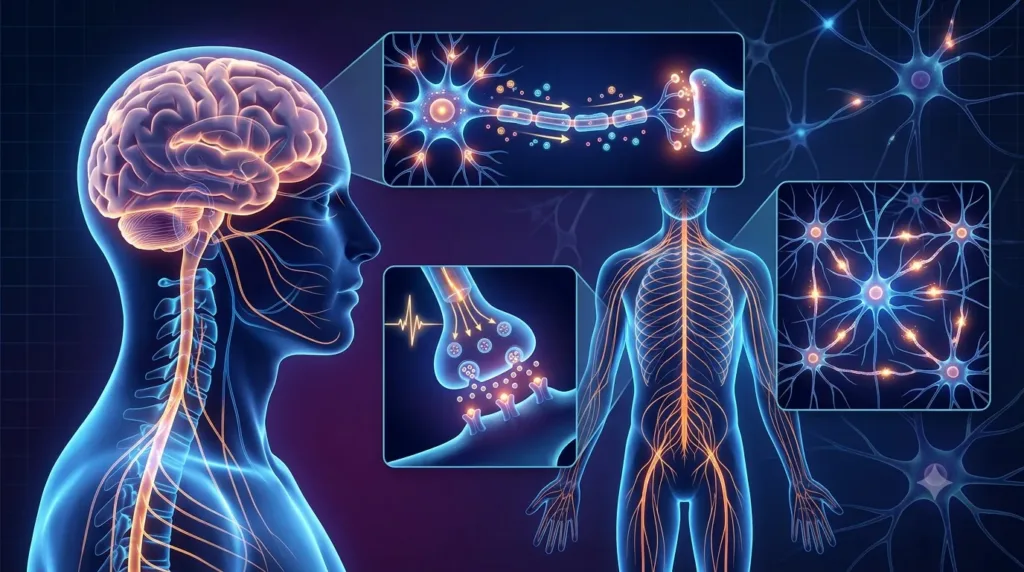
The human nervous system is an extensive network responsible for receiving, conducting and processing information. Thanks to it, the body can respond efficiently to stimuli from its surroundings and control the work of the internal organs. Its activity includes both conscious decisions and automatic processes such as breathing, muscle tone, digestion or the regulation of body temperature. To understand how it works, it is worth taking a closer look at how nerve cells transmit signals, what role the nerve impulse plays and why the central and peripheral nervous systems must constantly work together.
Structure of the nervous system – from the brain to the peripheral nerves
The structure of the nervous system is based on two main parts: the central and the peripheral nervous system. The central nervous system comprises the brain and the spinal cord. This is where information is analysed, responses are formed, memories are stored and complex vital functions are controlled. The peripheral nervous system is made up of the human peripheral nerves, which connect the brain and spinal cord with the muscles, skin and internal organs. The article on the structure of the human nervous system describes this system in more detail and sets out its basic anatomical divisions.
How does the nervous system work at the cellular level?
To explain how the nervous system works, you have to start with the neuron, the basic nerve cell. A neuron receives signals, processes them and passes them on to other cells. The information may come from the senses, the internal organs or other parts of the nervous system. Put simply, it resembles a communication network in which every signal must be correctly received, interpreted and sent to the right place. The nerve impulse – a rapid electrical change travelling along the nerve fibre – is of enormous importance here. It is what makes an immediate response to touch, pain, sound, light or a change in body position possible.
The nerve impulse – what is a neuron's electrical signal?
A nerve impulse arises when a neuron is excited by a sufficiently strong stimulus. The distribution of ions across the cell membrane then changes, producing a brief electrical signal. This signal travels along the axon, the long projection of the neuron responsible for transmitting information. Nerve impulses are conducted extremely quickly, especially in fibres surrounded by a myelin sheath. Myelin acts as an insulator and allows the signal to jump between special gaps in the sheath. As a result, the human nervous system can respond almost instantly to stimuli that require a rapid response.
Conduction of nerve impulses and the role of synapses
The conduction of nerve impulses does not end with a single neuron. The signal must be passed on to the next cell, and the site of this contact is the nerve synapse. In most synapses, information does not pass directly as an electrical impulse but by means of chemical substances. These are neurotransmitters, which are released from the ending of one neuron and act on the receptors of the next cell. In this way the signal can be amplified, dampened or stopped. This is an extremely important mechanism, because the nervous system not only transmits information but also selects it. As a result, the body does not react identically to every stimulus it receives.
Neurotransmitters – the chemical language of the nervous system
Neurotransmitters can be regarded as chemical messages sent between nerve cells. The best known include:
- acetylcholine,
- dopamine,
- serotonin,
- noradrenaline,
- glutamate,
- GABA.
Each of them performs specific tasks and takes part in different processes, such as concentration, mood, arousal, response inhibition or motor control. The nerve synapse therefore acts as a decision point at which information is either passed on or blocked. This shows that the nervous system works not only at an electrical but also at a biochemical level. Efficient communication between neurons is the basis for coordinating the whole body.
The central nervous system – the centre for analysing information
The central nervous system is responsible for analysing data and working out the body's responses. The brain processes information from the senses, compares it with previous experience and makes decisions. The spinal cord, on the other hand, has a conducting function but also takes part in unconditioned reflexes that do not require the conscious involvement of the brain. One example is quickly withdrawing your hand after touching a hot surface. Such a reaction happens in a flash because the nerve impulse travels through the so-called reflex arc. The structure of the nervous system therefore allows conscious control, automatic regulation and immediate protection of the body against danger at the same time.
The peripheral nervous system – connecting the centre with the rest of the body
The peripheral nervous system forms a dense network of nerves that branch off from the brain and spinal cord. Peripheral nerves are a kind of communication route connecting the control centre with individual tissues. The peripheral nervous system comprises sensory, motor and autonomic nerves. Its functions consist of receiving information from receptors, passing commands to the muscles and regulating the work of the organs. This makes it possible to move, feel temperature or pain, keep your balance and control processes that usually take place outside our awareness.
The most important stages of neural information processing
Information processing in the nervous system follows a specific sequence. First, a receptor picks up a stimulus – for example light, pressure, sound or a change in temperature. The nerve impulse is then transmitted to the relevant structures, where the information is analysed and compared with other signals. Only then is a response produced, which may take the form of movement, a change in muscle tension, the secretion of substances by glands or an adjustment in organ function. Several basic stages of this process can be distinguished:
- reception of the stimulus by a specialised receptor;
- conversion of the stimulus into a nerve impulse;
- conduction of nerve impulses to the central nervous system;
- analysis of the information and selection of a response;
- transmission of the signal to muscles, glands or organs.
This scheme shows that the human nervous system works like a system of continuous monitoring. It is not limited to a single signal but integrates many pieces of information at the same time. This allows the body to maintain its balance even when many different stimuli reach it at once.
How does the nervous system work with other body systems?
The nervous system does not function in isolation. It works closely with the endocrine, muscular, immune, circulatory and digestive systems. One example is the stress response, in which a stimulus is processed by the central nervous system and then triggers a cascade of hormonal and physiological responses. As a result, the heart rate speeds up, muscle tension increases, and the breathing rhythm and level of alertness change. Similar relationships apply to sleep, recovery, metabolism and temperature control. That is why analysing how the nervous system works requires a broader view of the whole body. It is a system of overarching coordination that organises the responses of many tissues simultaneously.
Why is understanding the nervous system so important?
Understanding how the nervous system works makes it possible to interpret the body's reactions better. Every movement, reflex, emotion, decision and sensation is the result of information being processed by neurons. The structure of the nervous system shows that even a simple reaction requires many elements to work together: receptors, peripheral nerves, the spinal cord, the brain, synapses and neurotransmitters. Nerve impulse conduction ensures the right speed of action, while synapses allow signals to be regulated precisely. As a result, the human nervous system can simultaneously control the body, receive stimuli, learn and adapt to a changing environment.
AminoX's range also includes food supplements such as magnesium citrate with vitamin B6, whose ingredients contribute to the normal functioning of the nervous system. Magnesium and vitamin B6 are important for, among other things, neuron function, maintaining electrolyte balance and reducing tiredness, so they can be a valuable addition to the daily diet.
Summary
The human nervous system is a system that ties together the reception of stimuli, the analysis of information and the control of the body's responses. The nerve impulse is responsible for the rapid transmission of signals, impulse conduction allows data to be sent efficiently between structures, and neurotransmitters enable the exchange of information at synapses. The central nervous system analyses the data, while the peripheral nervous system is responsible for transporting it between the centre and the rest of the body.


