
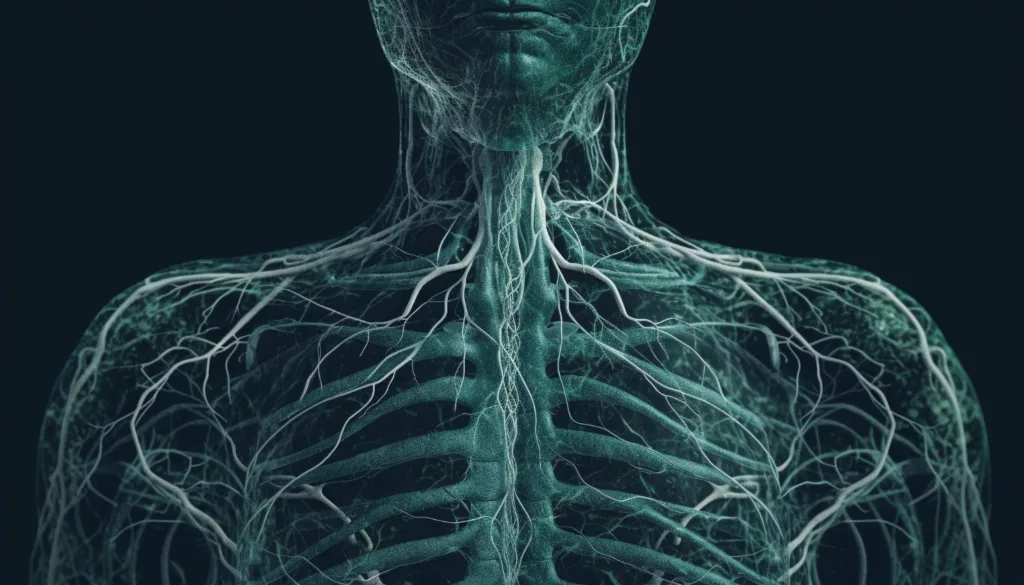
The nervous system works by continuously receiving signals, selecting and integrating them, and then generating a response adapted to the situation. When you touch a hot object, hear a sound or plan a movement, the activity of many cells and circuits is coordinated in a split second. The nervous system is not a simple wire, however: it interprets information in the light of memory, the state of the body and the current surroundings.
The structure of the information-processing system
The human nervous system has a multi-level structure. Its foundation consists of neurons and the glial cells that support them. A neuron is made up of the cell body, dendrites that receive signals and an axon that conducts the impulse to other cells. Among other things, glial cells maintain a suitable environment in the nervous tissue, support the neurons and form the myelin sheaths.
At a higher level, cells form local circuits, and these join into extensive networks responsible for sensation, movement, memory, emotions and the control of organ function. Analysing the human nervous system – its structure and functions – therefore means taking into account both individual synapses and the cooperation of entire areas of the brain, the spinal cord and the nerves.
The central and peripheral nervous system
Anatomically, a distinction is made between the central nervous system, comprising the brain and spinal cord, and the peripheral nervous system, which includes the nerves and ganglia. The central part of the system integrates signals, while the peripheral part connects it with receptors, muscles, glands and internal organs.
Both parts work together within a two-way flow of information. Sensory signals travel from the receptors towards the spinal cord and brain, and motor or autonomic commands return to the muscles, glands and organs. So these are not two independent systems, but elements of a single communication loop.
In the functional division of the peripheral part, the somatic and autonomic nervous systems are distinguished, among others. The first is associated with receiving sensory information and controlling skeletal muscles. The second regulates processes that you do not usually control consciously, such as heart activity, the tension of vessel walls or the activity of the digestive tract.
How does a signal travel within a neuron?
To understand how the human nervous system works, you need to distinguish between signal conduction within a neuron and communication between cells. The neuron's membrane maintains a difference in ion concentrations. Once a certain threshold is exceeded, an action potential arises – a brief change in electrical voltage that spreads along the axon.
The myelin sheath insulates the axon, and the gaps between its segments enable saltatory conduction of the impulse. As a result, the signal can travel more efficiently than in an unmyelinated fibre. The information itself does not depend solely on the presence of a single impulse. The firing frequency, its timing and the activity pattern of a whole group of cells also matter.
Neurons and the transmission of information across synapses
The transmission of information by neurons should be viewed as the work of a network rather than of a single cell. When the action potential reaches the end of the axon, it can lead to the release of a neurotransmitter into the synaptic cleft. These molecules bind to receptors on the next cell and change the likelihood that it will be excited. The messengers and modulators used by the nervous system also include certain peptides, referred to in this context as neuropeptides.
The transmission of information between neurons can be excitatory or inhibitory. The receiving neuron sums up the signals arriving at different times and from many synapses. Only the result of this integration determines whether a further action potential is generated. Inhibition is not an absence of activity – it makes it possible to limit unnecessary excitation, increase the contrast between signals and control the response precisely.
Not all synapses are chemical. In electrical synapses, ions flow directly between cells through gap junctions. Such a connection allows very fast and synchronised communication, although chemical synapses, which are more amenable to regulation, play a huge role in the human nervous system.
From stimulus to response
The most important functions of the nervous system can be summed up as three linked stages: receiving information, integrating it and generating a response. Receptors convert the energy of a stimulus – for example light, pressure or a change in temperature – into an electrical signal. The nervous system compares it with other data and triggers an appropriate response from muscles, glands or organs.
Not every piece of information has to reach consciousness. A good example is the spinal reflex. The sensory signal is passed to the spinal cord, where it can quickly trigger a motor response before the brain has analysed the event more fully. This is why you pull your hand away from a source of pain almost automatically, and conscious recognition of the stimulus follows a moment later.
The processes taking place in the nervous system also include the regulation of breathing, sleep, attention, emotions and the body's internal balance. Individual tasks do not usually have a single isolated centre. They arise from the dynamic cooperation of specialised but interconnected networks.
Plasticity, learning and network change
The nervous system does not process every signal according to a fixed pattern. Experience can strengthen frequently used connections, weaken others and change the organisation of the network. This ability matters for learning, memory and adapting to new conditions.
Brain plasticity does not mean that every lost cell is replaced. The change may involve modifying the strength of synapses, forming new connections or other areas taking over some of the tasks. In the adult central nervous system, regeneration remains limited. Some damaged axons in the peripheral nervous system can regrow if the neuron's cell body is preserved and the conditions in the tissue allow it.
Comparing the brain to a computer system is useful but incomplete. The brain simultaneously processes signals and rebuilds its own structure under the influence of activity. The outcome is also influenced by emotions, attention, previous experience and the physiological state of the body. If you would like to learn more about the structures involved in these processes, see our overview of the anatomy: the human nervous system.
Summary
The nervous system forms an extensive network that receives stimuli, analyses information and coordinates the responses of the whole body. Its function depends both on efficient impulse conduction in neurons and on communication between cells via synapses. Another important feature of this system is plasticity, which allows nerve connections to change under the influence of experience, learning and activity.
Understanding these mechanisms makes it possible to take a closer look at the processes taking place in the brain and the peripheral nervous system. If you are also interested in the products for research work in our range, visit the AminoX peptide shop and take a look at the available range.


