
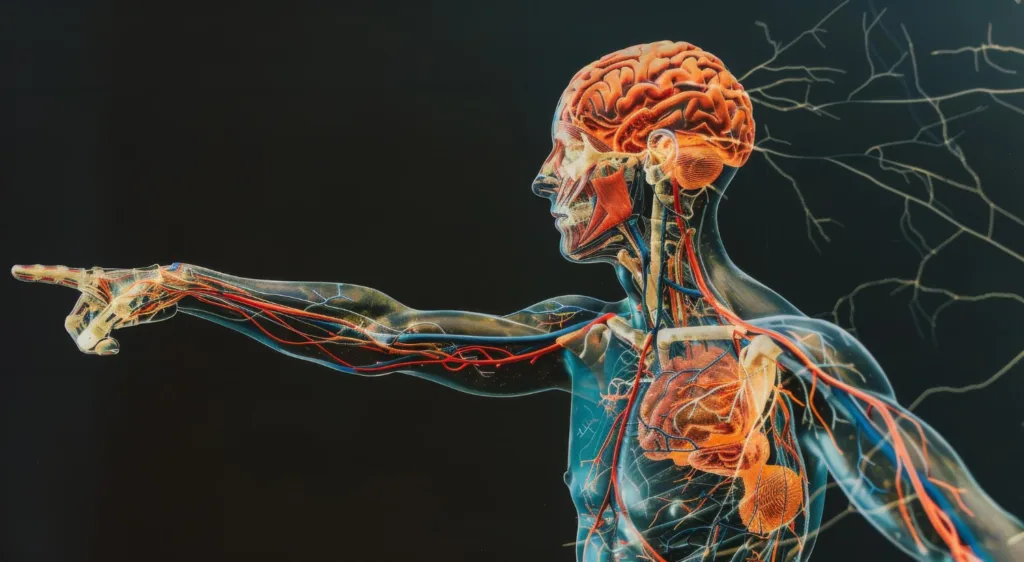
The human nervous system is responsible for receiving stimuli, analysing information and triggering the body's responses. Every movement, reflex or change in organ activity has its origin in a signal passed between nerve cells. To understand how it works, it is worth following the path of information – from the generation of a nerve impulse, through its conduction and the synapses, to the response of a muscle, gland or other effector cell.
How does a nerve impulse arise?
A nerve impulse is a brief change in the electrical potential of the neuron's membrane. It arises when a sufficiently strong stimulus changes the membrane's permeability to ions – mainly sodium and potassium. This leads to depolarisation, followed by repolarisation and the cell's return to its resting state. This is how conduction of the impulse in the neuron begins. It is the basic mechanism that enables nerve cells to pass on information in an instant. A detailed description of the structures responsible for these processes can be found in the article explaining the structure of the human nervous system – its organisation is closely linked to the way signals are transmitted.
What is nerve impulse conduction?
Impulses are conducted along the axon, the long projection of the neuron. The action potential triggers further voltage changes in neighbouring sections of the membrane, so that the signal moves in a specific direction. In neurons covered with a myelin sheath, this process is much faster because the excitation jumps between the nodes of Ranvier – this is known as saltatory conduction. The activity of neurons therefore depends both on the properties of the cell membrane itself and on the structure of the axon.
Electrical and chemical transmission – how do neurons pass on information?
Electrical and chemical transmission are two complementary communication mechanisms. Within the neuron the signal is electrical, whereas at most synapses it is transmitted chemically. When the impulse reaches the end of the axon, neurotransmitters are released and bind to receptors on the next cell. Synapses and neurotransmitters can increase or decrease the likelihood of that cell being excited, which ensures precise regulation of the whole communication process.
The path of a nerve impulse – from receptor to effector
The path of a nerve impulse begins at a receptor that detects a change in the external or internal environment. The information then travels via sensory neurons to the central nervous system, where it is processed and combined with other signals. The response is sent via motor neurons to the effector, e.g. a muscle or gland. The body's response to a stimulus can be fast and reflexive or may require the involvement of higher brain centres.
How does the nervous system's biological response arise?
A biological response is the result of processing a signal and passing it on to an effector cell. It may take the form of a muscle contraction, a change in secretion by a gland or a modification of the activity of specific neural networks. The human nervous system coordinates both voluntary responses and numerous autonomic processes, forming, together with the body's responses, a single coherent regulatory system.
How does the nervous system work during a simple reaction?
The way the nervous system works is well illustrated by the reflex of pulling your hand away from a hot object. Sensory receptors register the stimulus, and the nerve impulse travels directly to the spinal cord. There, the signal is instantly passed on to motor neurons, so the response occurs even before the brain has fully and consciously recognised the stimulus. These mechanisms involve several consecutive stages:
- the receptor picks up the stimulus;
- the sensory neuron passes the information to the central nervous system;
- interneurons integrate the signal;
- the motor neuron conducts the impulse to the effector;
- the muscle or gland carries out the response.
Each of these stages requires efficient communication between neurons. Reaction time depends, among other things, on the length of the nerve pathway, the presence of a myelin sheath and the number of synapses the information has to pass through. The relationship between the structure and function of the nervous system forms a coherent system in which the structure of individual elements translates directly into the speed and precision of the response. This is precisely why the response to stimuli can occur in a fraction of a second.
What matters for the normal functioning of the nervous system?
Normal neuronal activity depends on many factors, including ion balance, the availability of energy and an adequate supply of nutrients. Magnesium contributes to the normal functioning of the nervous system and muscles, while vitamin B6 supports the work of the nervous system and normal energy-yielding metabolism. Sleep, recovery and a balanced diet are also crucial.
The AminoX range – research reagents and support for the body
Advanced laboratory work on metabolic pathways, cellular communication or neurobiology requires chemical substances of the highest quality. The professional AminoX peptide shop supplies high-grade reagents intended exclusively for scientific research purposes. The range includes a variety of peptides, among them TB-500, valued in research on regeneration and cellular structure, the α-MSH hormone analogue Melanotan 2, and the ERR receptor agonist SLU-PP-332. Alongside research reagents, the range also includes high-quality food supplements that support the body's everyday functioning, such as magnesium citrate with vitamin B6, which helps maintain the normal functioning of the nervous system.
Summary
The human nervous system works thanks to a precise flow of information – from the generation of the action potential, through impulse conduction and communication at the synapses, to the activation of the effector. Understanding these stages makes it easier to see where the body's response to stimuli comes from and why even a simple reflex requires many cells to work together. Explore the full AminoX range to choose research reagents and supplements suited to your needs.


