
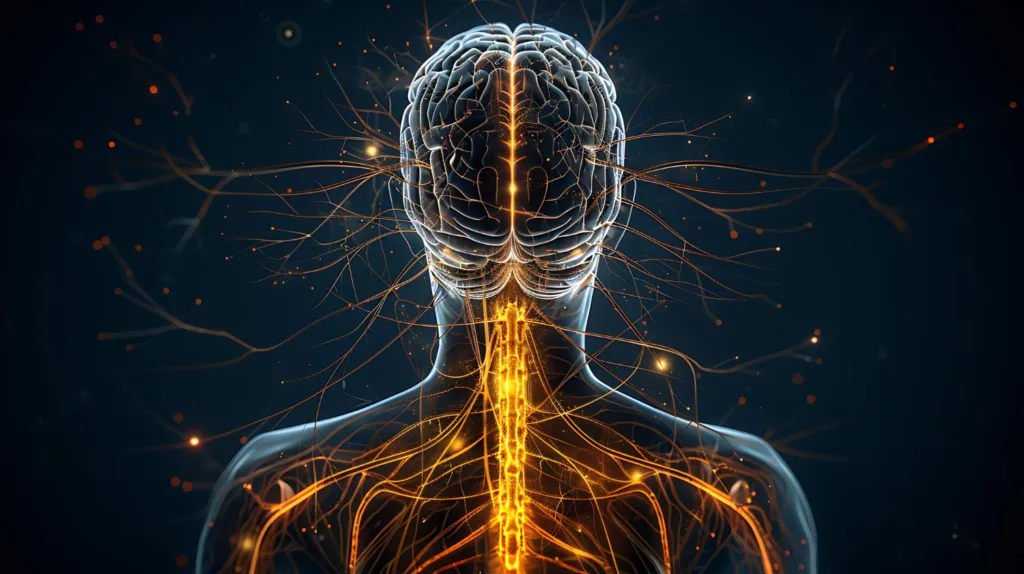
The structure of the human nervous system shows how a complex system controls movement, sensation, memory, emotions and organ function. The human nervous system receives stimuli, processes information and sends responses to muscles and glands. This is what allows you to make a conscious movement, pull your hand away from a hot surface or breathe without constantly thinking about it.
How is the nervous system organised? From the cell to the whole system
The organisation of the nervous system begins at the level of cells. The most important unit is the neuron – a cell capable of receiving, analysing and transmitting signals. The structure of a neuron comprises the cell body, dendrites and the axon. The dendrites take in information, the cell body integrates it and the axon passes the impulse on. Neurons and glial cells make up nervous tissue, which maintains a rapid flow of information. Glial cells support neurons, form myelin sheaths and protect the environment of the brain. This anatomy allows the nervous system to respond quickly and precisely.
The structure of the neuron and the conduction of nerve impulses
The conduction of nerve impulses consists of an electrical signal moving along the neuron. When the impulse reaches the end of the axon, the information can be passed on across a synapse, usually with the involvement of neurotransmitters. Neurobiological research analyses substances associated with communication between neurons, plasticity and the response to cellular stress.
Divisions of the nervous system – central and peripheral nervous system
The nervous system can be divided anatomically and functionally. Anatomically, a distinction is made between the central nervous system and the peripheral nervous system. The central nervous system is made up of the brain and spinal cord, the centre where information is analysed. The peripheral nervous system comprises the nerves: cranial nerves, spinal nerves and ganglia. It connects the control centre with the rest of the body, which is why signals from receptors reach the brain and spinal cord, and responses return to the muscles and organs. This division shows how the human nervous system stays in contact with the body.
The central nervous system – brain and spinal cord
The central nervous system is responsible for analysing stimuli, coordinating movement, memory, emotions, speech, learning and the control of vital processes. The brain and spinal cord are protected by the skull, the spine, the meninges and cerebrospinal fluid. The brain comprises the cerebral cortex, the cerebellum, the brainstem and subcortical structures. The spinal cord conducts impulses between the brain and the peripheral nerves and is responsible for many reflexes.
The peripheral nervous system – connecting the centre with the body
The peripheral nervous system works like a network of information cables. It carries sensory signals from the receptors to the central nervous system and passes commands from the brain and spinal cord to the effector tissues. It includes 12 pairs of cranial nerves and 31 pairs of spinal nerves. It comprises sensory, motor and autonomic fibres, so it is involved in both conscious movement and organ function.
The somatic and autonomic nervous system
Functionally, the nervous system is divided into the somatic nervous system and the autonomic nervous system. The somatic nervous system is responsible for conscious movements of skeletal muscles and for receiving stimuli from the skin, muscles and sense organs. It is what allows you to change your body position or recognise touch, temperature and pain. The autonomic nervous system regulates processes that are independent of the will, such as heart rate, digestion, vascular tone, glandular secretion and stress responses. This division of the nervous system shows that the body performs both conscious and automatic activities.
The sympathetic and parasympathetic systems – a balance of responses
The autonomic nervous system consists mainly of the sympathetic and parasympathetic parts. The sympathetic part mobilises the body in situations of stress, exertion or danger. The parasympathetic part supports rest, digestion and the return to balance.
- The sympathetic system speeds up the heart rate and increases readiness for action.
- The parasympathetic system slows down the heart and supports digestion.
- The two systems work alternately, depending on the situation.
- Their balance helps keep the functions of the nervous system stable.
In practice, neither part should dominate permanently. The body needs to switch flexibly between activation and calming down. Research into neurobiology also covers adaptation, cellular regeneration and communication between the nervous system and other tissues.
How does the nervous system work in practice?
How does the nervous system work during an ordinary response to a stimulus? First, a receptor picks up information, such as touch, pain, light or a change in temperature. The impulse then travels to the spinal cord or brain, where it is analysed. The human nervous system then sends a response to the effector, that is, a muscle or gland. In a simple reflex, the decision can already be made in the spinal cord. In more complex activities, the brain compares the stimuli with memory and the current goal of the action.
Functions of the nervous system and the importance of laboratory research
The functions of the nervous system include receiving information, conducting nerve impulses, analysing stimuli, controlling movement, regulating organs, memory, attention, emotions and learning. The structure of the human nervous system is adapted to these tasks: neurons transmit signals, glial cells support their work, and the brain and spinal cord integrate information from the body. Laboratories study neuroplasticity, synaptic communication, oxidative stress and regenerative processes.
Summary
The structure of the human nervous system is based on the cooperation of neurons, glial cells, the brain, the spinal cord and the peripheral nerves. The central nervous system analyses information and coordinates responses, while the peripheral nervous system connects it with the rest of the body. The somatic nervous system is responsible for conscious movement and sensation, whereas the autonomic nervous system regulates processes independent of the will. This organisation allows the nervous system to respond to change and maintain balance.


